Why Your Foam Roller Feels Completely Different Week to Week — A Full Breakdown
Quick Answer: The same foam roller pressing into the same muscle can feel dramatically different from one session to the next because muscle tension, hydration status, recent training load, nervous system sensitivity, and even stress levels all independently affect how tissue responds to pressure — the roller isn’t inconsistent, the body meeting it is.
A roller that felt tolerable on Monday and unbearable on the same spot Wednesday isn’t malfunctioning — that’s a genuinely different physiological state being pressed into.

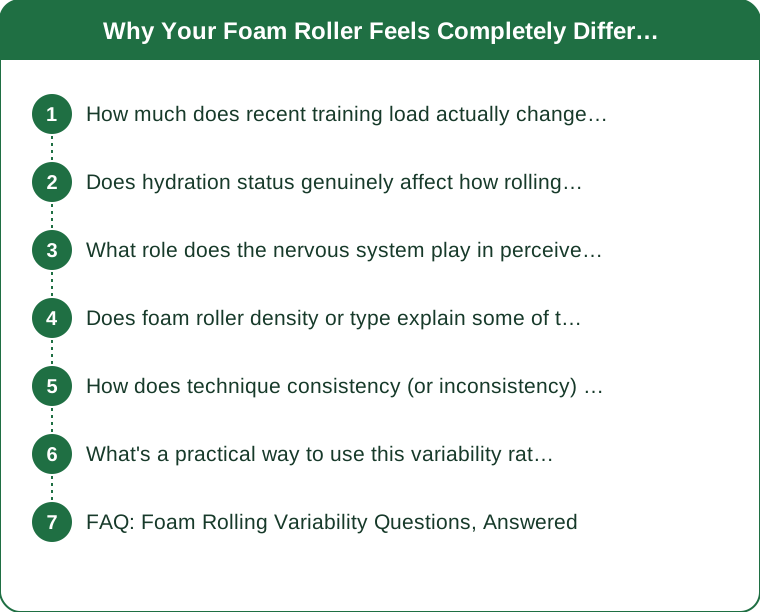
How much does recent training load actually change rolling sensation?
Substantially — muscle tissue that’s freshly fatigued or has accumulated microtrauma from a hard training session is measurably more sensitive to pressure than tissue that’s had adequate recovery time, which is why rolling the same muscle group the day after an intense leg session often feels far more intense than rolling it on a lighter training day, even with identical roller pressure and technique. This is a normal protective response, not a sign that something is wrong with either the muscle or the rolling technique.
Does hydration status genuinely affect how rolling feels?
Yes, meaningfully — well-hydrated muscle and fascia tissue tends to have somewhat better tissue quality and glide, which can make rolling feel smoother and less sharply uncomfortable, while dehydrated tissue can feel stiffer and more reactive to the same pressure, adding another variable that has nothing to do with the roller itself or how tight a muscle ‘really’ is.
What role does the nervous system play in perceived rolling intensity?
A significant one — pain and pressure perception aren’t purely mechanical; they’re processed and modulated by the nervous system, which is itself affected by stress, sleep quality, and general anxiety levels. On a high-stress or poorly-slept day, the nervous system tends to be in a more sensitized state, which can make the same physical pressure register as more intense discomfort than it would on a well-rested, low-stress day, independent of any actual change in muscle tissue.

Does foam roller density or type explain some of the variability too?
Yes, but usually as a secondary factor — softer rollers distribute pressure over a wider area and generally feel gentler, while firmer or textured rollers concentrate pressure and typically feel more intense; switching roller types without realizing it, or using a roller that’s degraded and softened with age, can account for some of the week-to-week difference alongside the physiological factors.
How does technique consistency (or inconsistency) contribute to the variability?
Subtle differences in body positioning, how much bodyweight is actually loaded onto the roller, and rolling speed all change effective pressure meaningfully, and these details are easy to apply inconsistently session to session without noticing — someone who unconsciously supports more of their weight with their hands on a stressful, distracted day will get a genuinely lighter session than one where they fully commit their weight onto the roller.
What’s a practical way to use this variability rather than being confused by it?
Treating rolling intensity as information about current tissue and nervous system state — a noticeably more sensitive session might be a signal to ease off intensity or address recovery elsewhere, rather than pushing through the same pressure regardless of how the day is actually going, tends to make rolling more useful and less frustrating over time.
FAQ: Foam Rolling Variability Questions, Answered
Is it normal for one side of the body to feel different than the other during the same session?
Yes, quite commonly — asymmetries in training load, daily movement patterns, and even sleeping position can make one side genuinely more sensitive than the other on a given day, without indicating a structural problem.
Should rolling technique stay exactly the same every session regardless of how it feels?
Not necessarily — adjusting pressure (by shifting more or less bodyweight onto the roller) based on how a session feels that day is a reasonable, body-responsive approach rather than rigidly forcing identical pressure regardless of tissue state.
Does this variability mean rolling isn’t a reliable recovery tool?
No — the variability is expected and doesn’t undermine rolling’s usefulness, it just means intensity should be treated as flexible day to day rather than assuming the ‘right’ pressure is a fixed, unchanging number.
TL;DR:
- Recent training load changes tissue sensitivity to the same rolling pressure
- Hydration status affects tissue quality and how rolling actually feels
- Stress and sleep influence nervous system sensitivity to pressure, independent of muscle tightness
- Roller type and subtle technique differences add further session-to-session variability
- Treating intensity as flexible day to day makes rolling more useful than expecting consistency
The roller staying the same while the sensation changes is the body giving real information, not a sign of an inconsistent tool.
Keep Reading
This article is for general informational purposes only and is not medical advice. Always consult a qualified health professional for guidance specific to you.