The Complete Foam Rolling Routine, Broken Down by Training Split
Quick Answer: A generic full-body foam rolling routine spends equal time everywhere, which wastes time on areas that aren’t actually tight from that day’s training — matching your foam rolling routine to your training split (legs, push, pull, or rest day) targets the muscles actually under the most tension, making the same 10-15 minutes noticeably more effective.
Rolling your whole body for ten minutes after every single workout treats a leg day and an upper body day identically. The muscles under tension that day are anything but identical.

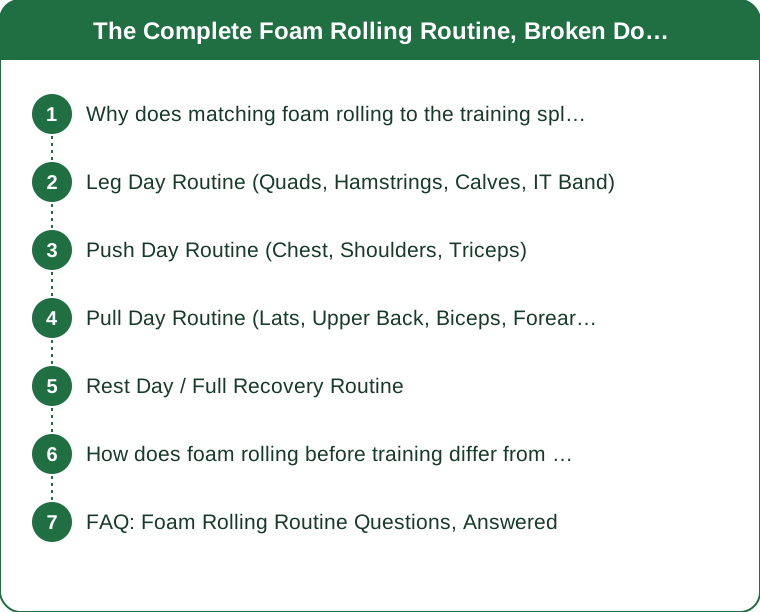
Why does matching foam rolling to the training split actually matter?
Foam rolling works by applying sustained pressure to reduce tension and improve blood flow in a specific muscle, and its effect is fairly localized — rolling your quads does very little for tightness in your lats. A generic routine that splits time evenly across the whole body, regardless of what you actually trained, spends a meaningful chunk of limited time on areas that aren’t under elevated tension that day, while under-serving the areas that actually need it most.
This matters most for people with limited post-workout time — 5 minutes focused on the 2-3 muscle groups actually worked that day produces more noticeable relief than 5 minutes spread across the entire body regardless of what was trained.
Leg Day Routine (Quads, Hamstrings, Calves, IT Band)
Quads: 60-90 seconds each leg, rolling from hip to just above the knee, pausing on tender spots for 15-20 seconds rather than rolling continuously through them. Hamstrings: 60 seconds each leg, seated position with the roller under the back of the thigh. Calves: 45-60 seconds each leg — often more tender than expected, so lighter pressure (cross the opposite leg over to reduce body weight) works better here than full pressure. IT band: 30-45 seconds each side, done lightly — this area responds better to shorter, gentler passes than aggressive rolling, contrary to common advice.
Push Day Routine (Chest, Shoulders, Triceps)
Chest: 45-60 seconds each side, using a smaller ball rather than a full roller for better control around the shoulder joint. Triceps: 45 seconds each arm, roller against a wall or floor depending on comfort. Upper back/shoulders: 60-90 seconds, focusing especially on the area between the shoulder blades where push-day tension commonly concentrates.

Pull Day Routine (Lats, Upper Back, Biceps, Forearms)
Lats: 60-90 seconds each side, lying on your side with the roller under the armpit area — this is a commonly neglected spot that carries significant tension after heavy pulling work. Upper back: 60-90 seconds, rolling the full width rather than just the center. Forearms: 30-45 seconds each arm, using a smaller ball, especially useful after grip-intensive pulling exercises like deadlifts or rows.
Rest Day / Full Recovery Routine
On rest days, a lighter, full-body pass (2-3 minutes total, roughly 20-30 seconds per major area) supports general circulation and recovery without needing the targeted, longer-duration focus of a training-day routine. This is also a good day to work on any area that’s felt persistently tight across the week, since there’s no competing acute tension from a fresh workout to prioritize instead.
How does foam rolling before training differ from after?
Foam rolling before training is typically shorter and lighter (30-45 seconds per area) and functions more as part of a dynamic warm-up, increasing blood flow and range of motion before the workout begins. Foam rolling after training can be longer and more focused on specific tender spots, since the goal shifts from preparation to actual recovery and tension release from the session just completed.
FAQ: Foam Rolling Routine Questions, Answered
Is it necessary to foam roll every single day?
No — matching sessions to actual training days, plus a lighter pass on rest days, is generally more effective than daily rolling regardless of what (if anything) was trained that day.
How much pressure should be used on tender spots?
Enough to feel noticeable pressure without sharp pain — a dull, tolerable discomfort is the target; genuine pain is a sign to ease off or move to a different spot.
Can foam rolling replace stretching entirely?
They serve different purposes and work well together rather than as substitutes — foam rolling addresses tissue tension while stretching addresses range of motion, and combining both tends to work better than relying on just one.
TL;DR:
- Matching foam rolling to your training split targets the muscles actually under tension that day
- Leg, push, and pull days each have a distinct set of priority areas and rough time allocations
- Rest days call for a lighter, general full-body pass rather than the same targeted focus
- Pre-workout rolling should be shorter and lighter than post-workout rolling
Ten minutes of foam rolling isn’t a fixed routine — matched to what you actually trained, the same time investment does noticeably more.
Keep Reading
This article is for general informational purposes only and is not medical advice. Always consult a qualified health professional for guidance specific to you.