How Long Should You Actually Foam Roll Each Muscle? The Dosing Nobody Agrees On, Settled
Quick Answer: The research sweet spot is unglamorously short: 30-90 seconds per muscle group, at moderate (not maximal) pressure, is where the range-of-motion and soreness benefits appear — with little added from going past ~2 minutes. A full-body session is 8-12 minutes, not the 30-minute grind-fest the foam-rolling internet implies. Slow passes (2-3cm per second), breathe normally, and stop hunting for pain: discomfort around 5-7/10 outperforms the white-knuckle approach on every measure.
Foam rolling advice spans ‘20 seconds is plenty’ to ‘camp on each trigger point for five minutes,’ which mostly reveals that nobody checked the dosing studies. They exist, they’re fairly consistent, and they’re good news for everyone who hates foam rolling: the effective dose is small.

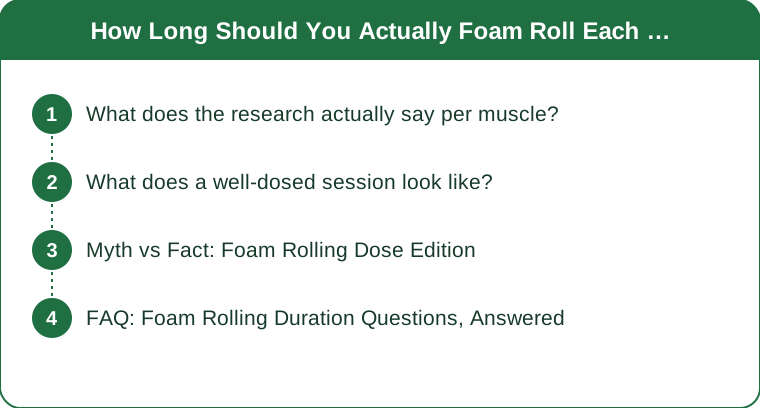
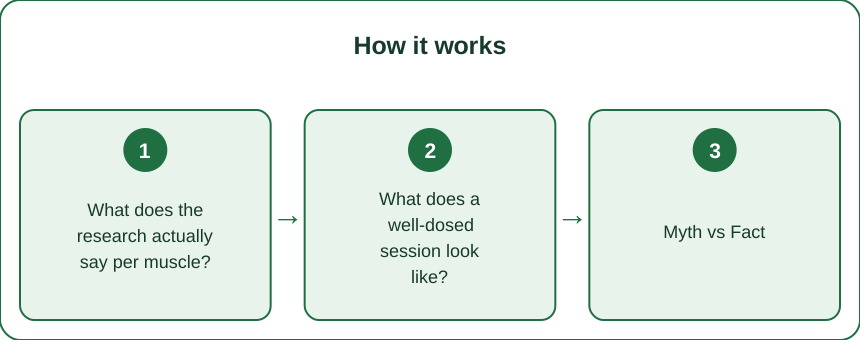
What does the research actually say per muscle?
The dosing picture from the rolling literature:
- 30-90 seconds per muscle group is where the measurable benefits — short-term range-of-motion gains, reduced soreness perception, no strength loss — reliably show up. Several studies find effects with as little as 30-60 seconds.
- Diminishing returns past ~2 minutes: more time adds little measurable benefit — the 5-minute quad excavation isn’t deeper therapy; it’s the same effect plus bruising and lost session time.
- Frequency beats marathon length: short doses repeated (daily or near-daily, especially during heavy training weeks) outperform the weekly mega-session — consistent with rolling’s mechanism being substantially neurological (changing the nervous system’s tension and sensitivity settings) rather than physically reshaping tissue.
- Pressure: moderate wins. The 5-7/10 discomfort zone — ‘attention-getting, breathable’ — performs as well as maximal pressure in comparisons, without the guarding (muscles bracing against the assault) that defeats the purpose. If you’re holding your breath, the nervous system is defending, not releasing.
The honest mechanism note: rolling’s benefits are real but short-term (think preparation and recovery-feel, hours not weeks) — which itself argues for the short-and-frequent dosing pattern.
What does a well-dosed session look like?
The 10-minute full-body template (timer recommended — everyone overshoots their least-favorite muscle and shortchanges the rest):
- Calves: 45s each
- Hamstrings: 45s each
- Quads: 60s each
- Glutes/piriformis area: 60s each side
- Upper back (thoracic): 60-90s
- Lats: 30-45s each
Technique that makes the short dose count:
- Slow passes: 2-3cm per second — the speed most people roll (fast see-sawing) turns the session into light massage theater; slow is what lets pressure register.
- When you find a tender spot: pause 20-30 seconds with steady breathing, add small movements (bend-straighten the knee on a quad spot) — then move on. Camping longer is the diminishing-returns zone.
- Breathe normally throughout — breath-holding is the guarding tell.
- Timing placement: pre-workout rolling (brief, 30-60s per area) pairs well with dynamic warm-up for range; post-workout or evening rolling suits the soreness-management job. Both is fine; neither replaces the warm-up itself.
The skip list: don’t roll bony prominences, the lower back directly (roll the glutes and upper back instead — the lower spine dislikes unsupported pressure), or anything with sharp, radiating, or joint pain — tender muscle is the target; pain with adjectives is a professional’s question. This is general information, not medical advice.

Myth vs Fact: Foam Rolling Dose Edition
Myth: You’re breaking up adhesions, so more grinding = more breaking. Fact: The force needed to mechanically deform fascia far exceeds what bodyweight rolling produces — the working mechanisms are substantially neurological (tone and sensitivity modulation) and circulatory. Which is precisely why moderate-and-repeated outperforms maximal-and-heroic: you’re negotiating with a nervous system, not sanding a table.
Myth: If it doesn’t hurt, it isn’t working. Fact: The comparisons keep finding moderate pressure matching brutal pressure on outcomes — pain past the 7/10 zone triggers guarding, the exact opposite of release. The no-pain-no-gain crowd is doing extra suffering for identical results.
Myth: Foam rolling replaces stretching, warm-ups, or strength work. Fact: It’s an adjunct with short-term effects — nice before training (range prep) and after (soreness perception), irrelevant to the structural adaptations that actually change tissue capacity (that’s progressive loading’s job). The roller is a 10-minute supporting actor being marketed as a lead.
The liberating summary: almost everyone can cut their rolling time in half and lose nothing — the effective product was always the small consistent dose.
FAQ: Foam Rolling Duration Questions, Answered
Should I roll every day?
During heavy training or high-soreness weeks, short daily sessions (5-10 minutes) fit the frequency-beats-length pattern well. Easy weeks: 2-3 sessions maintains the benefit. The dose that matters is the one that actually happens — which is the short one.
Is a massage gun dosed the same way?
Similar logic transfers: brief per-muscle applications (30-60s), moderate intensity, avoid bones and the sharp-pain rule. Guns trade the roller’s broad pressure for targeted percussion — same supporting-actor status, same overuse pattern (nobody needs 10 minutes of hammering one quad).
My IT band hurts to roll — should I push through?
The IT band is the classic example of misdirected effort: it’s a tendon-like structure that responds poorly to direct assault — roll the muscles that attach into it instead (quads, glutes, TFL area at the hip) and let the band itself retire from your rolling menu. Persistent lateral knee/hip pain: that’s an assessment question, not a pressure question. This is general information, not medical advice.
TL;DR:
- Effective dose: 30-90 seconds per muscle, moderate 5-7/10 pressure, slow 2-3cm/sec passes — full body in 8-12 minutes
- Past ~2 minutes per muscle = diminishing returns; frequency (short daily doses in heavy weeks) beats marathons
- Mechanism is mostly neurological — breathe normally; breath-holding means guarding, and guarding means too much pressure
- Skip the lower back and IT band directly; sharp or radiating pain is a professional’s question
The roller was never a excavation project — it’s a 10-minute conversation with your nervous system, and short polite conversations work best. This is general information, not medical advice.
Keep Reading
This article is for general informational purposes only and is not medical advice. Always consult a qualified health professional for guidance specific to you.