How to Actually Build a Foam Rolling Routine Instead of Randomly Rolling Whatever Feels Tight
Quick Answer: A structured foam rolling routine targets major muscle groups on a rotating schedule tied to training days — legs and hips on lower-body training days, upper back and shoulders on upper-body days, and a brief full-body pass on rest days — rather than reacting only to whatever feels tight that day.
Reactive rolling isn’t wrong, but it only ever addresses the muscle that’s already loudly complaining — a structured routine catches tightness before it becomes the muscle doing the complaining.

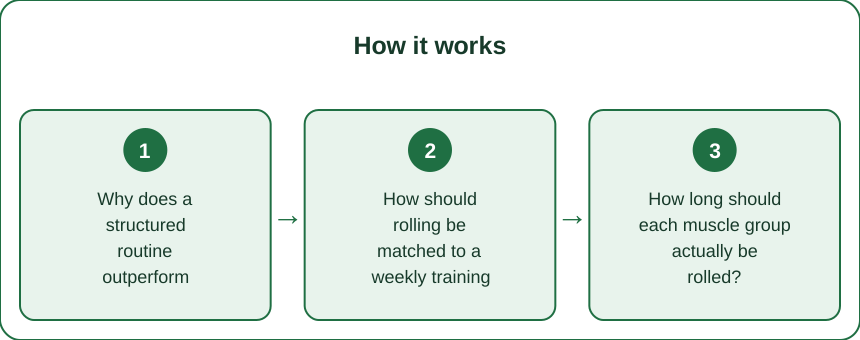
Why does a structured routine outperform random, reactive rolling?
Rolling only the muscle that feels tight in the moment means every other muscle group goes untouched until it also becomes uncomfortable enough to notice, which is a reactive rather than preventive approach. A structured routine spreads attention across all the major muscle groups over the course of a week, which tends to catch and address tightness earlier, before it becomes restrictive enough to affect training or daily movement.
There’s also a consistency benefit — a rotating schedule tied to existing training days is far easier to actually stick with than an open-ended “roll when something feels off” approach, which in practice often means rolling rarely or only during an active flare-up of tightness.
How should rolling be matched to a weekly training split?
Matching foam rolling to muscle groups actually being trained that day keeps the routine efficient and directly useful — quads, hamstrings, calves, and glutes on lower-body days, and lats, chest, and upper back on upper-body days, generally in the five to ten minutes before or after a session.
This timing matters: rolling immediately before training can help with mobility and readiness for the muscles about to be worked, while rolling after training helps manage the tightness a session itself creates. A brief, lighter full-body pass on rest days rounds out the week without requiring a long, dedicated session on days that are otherwise meant for recovery.
How long should each muscle group actually be rolled?
Somewhere between 30 and 60 seconds per muscle group is a reasonable target for most structured routines, with slower, controlled passes rather than fast back-and-forth rolling that doesn’t give tissue time to actually respond. Spending longer than roughly 90 seconds to two minutes on a single spot generally offers diminishing returns and can occasionally increase bruising or irritation instead of additional benefit.
A full structured session covering four to six muscle groups typically takes somewhere around 10 to 15 minutes total, which is short enough to realistically fit before or after a normal training session without feeling like a separate workout of its own.

Myth vs Fact: Structured Foam Rolling
Myth: foam rolling only needs to happen when a muscle already feels tight. Fact: a proactive, scheduled approach tends to prevent tightness from building up as severely in the first place, rather than only addressing it after the fact.
Myth: more time spent rolling a single spot always produces a better result. Fact: beyond roughly 60 to 90 seconds per area, additional time on the same spot generally doesn’t add meaningful extra benefit and can increase discomfort.
What are the most commonly overlooked muscle groups in a rolling routine?
Most people default to rolling quads and calves because they’re easy to reach and commonly tight, while areas like the upper back, glutes, and the muscles along the outer hip get skipped far more often despite being just as prone to tightness, especially for anyone who sits for long stretches during the day.
Building a routine that deliberately rotates through these less-obvious areas, not just the familiar ones, is one of the simplest ways to get more value out of the same total time spent rolling each week.
Myth vs Fact: What Rolling Can and Can’t Fix
Myth: foam rolling can permanently lengthen a muscle. Fact: rolling primarily affects short-term tissue sensation and perceived tightness rather than producing a lasting structural change in muscle length.
Myth: foam rolling is a substitute for actual mobility or stretching work. Fact: rolling works well as a complement to stretching and mobility drills, not a replacement for them, since each addresses a slightly different part of the tightness picture.
FAQ: Foam Rolling Program Questions, Answered
How many days a week should a structured rolling routine run?
Most people do well with rolling on 4 to 6 days a week, tied to training days, with lighter sessions on rest days.
Should foam rolling replace a dynamic warm-up?
No — rolling works best as a component alongside a dynamic warm-up, not a full substitute for movement-based preparation.
Is a denser or softer foam roller better for a structured routine?
Softer rollers are usually more comfortable for beginners building consistency, while denser rollers suit those with more experience who want deeper pressure.
TL;DR:
- A structured, schedule-based rolling routine catches tightness earlier than reactive rolling
- Match muscle groups rolled to the day’s training split for efficiency
- 30-60 seconds per muscle group is enough; more isn’t automatically better
- Don’t skip commonly overlooked areas like the upper back, glutes, and outer hip
- Rolling complements stretching and mobility work rather than replacing it
A few minutes of structured rolling tied to your training week beats an occasional reactive session on whatever muscle happens to be loudest that day.
Keep Reading
This article is for general informational purposes only and is not medical advice. Always consult a qualified health professional for guidance specific to you.