Roll AM or PM? Timing Your Release Work for the Job at Hand
Quick Answer: Both slots work, for different jobs. Morning rolling is a short primer — 30 to 45 seconds per stiff spot, five minutes total, to raise circulation and clear the overnight creak. Evening rolling is the longer, slower version that pairs with winding down for sleep. The third slot, within a few hours after training, has the strongest evidence for reducing next-day soreness.
Foam rolling has the same timing question stretching does, and it has the same pleasingly non-dramatic answer: both slots work, for different jobs.
Morning rolling is a systems check and a primer. Evening rolling is a pressure-release valve with sleep benefits attached. They’re not competing — they’re different tools that happen to use the same piece of foam.
Here’s how to match the session to the slot, plus the third timing window most people don’t use.

What Does Foam Rolling Actually Do?
Worth being clear before we schedule it, because the mechanism isn’t what most people think.
It doesn’t break up adhesions or “release” fascia in any structural sense. The forces involved aren’t close to what would be required to deform connective tissue mechanically.
What it does do, based on the reasonable evidence: it temporarily increases range of motion, it reduces the perception of muscle soreness, and it produces a short-term drop in tissue stiffness — probably through neural mechanisms rather than mechanical ones. Your nervous system responds to sustained pressure by reducing protective tone.
That’s a real, useful effect. It’s just a short-lived one, which is why frequency matters more than intensity, and why the best slot is the one you’ll actually keep.
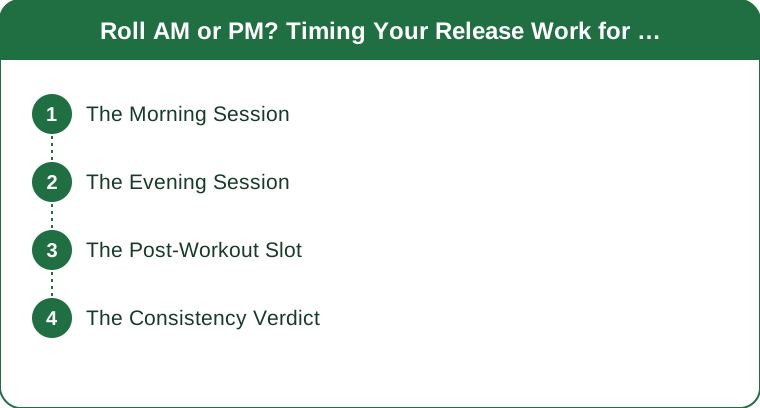
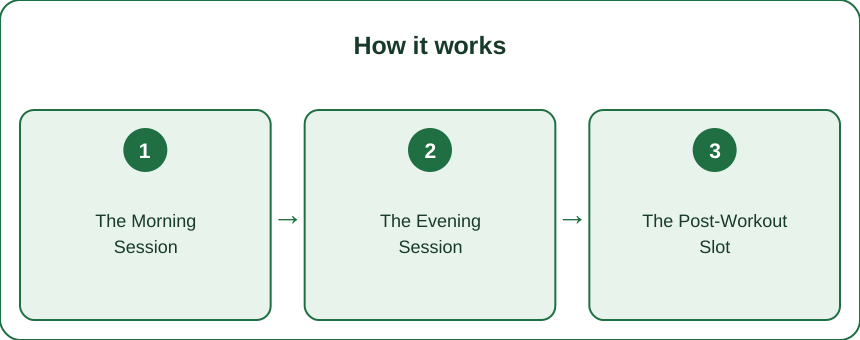
The Morning Session
Pre-day rolling runs short and functional. Think primer, not project.
Duration: five minutes, ceiling. If your morning roll takes 20 minutes, it’ll survive about two weeks.
Targets: the three reliable morning hotspots — calves, upper back, and the front of the hips. These are the areas that stiffen most overnight, particularly if you sleep on your side or sit a lot during the day.
Time per spot: 30 to 45 seconds. Slow passes, not frantic scrubbing.
Pair it with movement. Rolling alone doesn’t wake anything up. Follow it with a minute of dynamic movement — leg swings, arm circles, a few bodyweight squats — so the increased range gets used rather than just noticed.
The goal is circulation up, morning creak down, and out the door. Nothing more ambitious than that.
The Evening Session
The unwinding edition goes longer and slower, and it’s doing a different job.
Duration: 10 to 15 minutes. There’s time here.
The full six-spot tour: calves, hamstrings, quads, glutes, upper back, and lats. Two to three passes each, plus sustained holds on anything that’s genuinely tender.
Hold the tender points. Where the morning session moves through, the evening session can stop — 30 to 60 seconds of steady pressure on a spot that’s asking for it, breathing slowly the whole time.
The long exhale is the active ingredient. Sustained pressure plus slow breathing reads to your nervous system as a downshift signal. This is why evening rolling doubles as sleep hygiene without anyone designing it that way.
Do it 30 to 60 minutes before bed, with the lights already dimmed, and it slots neatly into a wind-down routine rather than competing with one.

The Post-Workout Slot
The third timing, and the one with the best evidence behind it.
Rolling within a few hours after training measurably reduces next-day muscle soreness. This is the strongest, most consistently replicated finding in the foam-rolling literature — better supported than the flexibility claims and considerably better supported than anything about fascia.
When: immediately after, or any time in the following few hours. Both work.
How long: 60 to 90 seconds per muscle group you actually trained. No need to tour everything.
How hard: moderate. Post-training tissue is already stressed, and aggressive rolling on top of it isn’t buying you anything.
Use it especially after the sessions your calendar labels “ambitious” — the long run, the heavy leg day, the first session back after two weeks off. That’s where the soreness you’re preventing would have been worst.
The Consistency Verdict
As with every piece of recovery work, the best slot is the one you keep.
For most people that’s the evening TV roll, and the reason is embarrassingly simple: the roller lives by the couch, and the couch does the scheduling. Proximity beats intention almost every time.
The practical rule: put the roller where you’ll see it during the window you’re most likely to have five spare minutes. Beside the couch, at the foot of the bed, next to your desk. A roller in a closet is a roller you don’t use.
Morning, evening, or post-training — the tissue cares about the frequency, not the clock. Three sessions a week in whatever slot fits beats a perfectly timed session you skip.
5 Mistakes Everyone Makes
- Rolling too fast. Racing up and down a muscle doesn’t give the nervous system time to respond. Slow passes, roughly an inch per second.
- Chasing pain as a measure of effectiveness. More pressure isn’t more benefit past a moderate point. If you’re bracing and holding your breath, you’ve overshot — which also blocks the relaxation response you’re trying to trigger.
- Rolling directly over joints or bone. Knees, the lower back over the lumbar spine, and the front of the shin are all places to work around rather than over.
- Rolling the IT band aggressively. It’s dense connective tissue that doesn’t lengthen, and it’s painful for no return. Roll the glutes and the tensor fasciae latae above it instead.
- Expecting it to fix a real problem. Rolling manages stiffness. It doesn’t treat an injury, a nerve issue, or persistent one-sided pain — those need a physical therapist or a clinician, especially if there’s numbness, tingling, or pain that’s getting worse.
Mini FAQ
Is it better to foam roll before or after a workout?
After has the stronger evidence — it reliably reduces next-day soreness. Before a workout, a brief roll can increase range of motion without the temporary strength reduction that long static stretching causes, so a short pre-session roll is a reasonable warm-up addition. If you only do one, do it after.
How long should you foam roll each muscle?
Thirty to 60 seconds per area for general work, up to 90 seconds post-training. Longer than two minutes on one spot has no additional benefit and increases the risk of irritating the tissue.
Can you foam roll every day?
Yes, provided you keep the pressure moderate. Daily short sessions are more useful than occasional long ones, since the effects on range of motion and stiffness are relatively short-lived. Back off if an area stays sore for more than a day after rolling it.
TL;DR:
- Morning: 5 minutes, 30–45 seconds each on calves, upper back, hips. Follow with dynamic movement.
- Evening: 10–15 minutes, full six-spot tour, hold tender points with long exhales. Doubles as sleep prep.
- Post-workout: 60–90 seconds per trained muscle group — the slot with the best evidence for reducing soreness.
- Roll slowly, keep pressure moderate, avoid joints and the IT band directly.
- The best slot is the kept one. Put the roller where you’ll see it.
Prime briefly in the morning, unwind thoroughly at night, hit the post-workout window when it matters. The roller works every shift — assign it the one your schedule will actually staff.
Keep Reading
This article is for general informational purposes only and is not medical advice. Always consult a qualified health professional for guidance specific to you.