The Complete Guide to Foam Rolling Differently for Desk Workers Versus Athletes
Quick Answer: Desk workers typically need foam rolling focused on hip flexors, upper back, and chest — areas tightened by prolonged sitting and forward posture — while athletes typically benefit more from rolling major muscle groups used in their sport, like quads, calves, and lats, meaning a one-size-fits-all rolling routine underserves both groups.
Most generic foam rolling guides assume a single audience, but the actual tightness patterns for someone sitting eight hours a day look very different from someone training for a race.
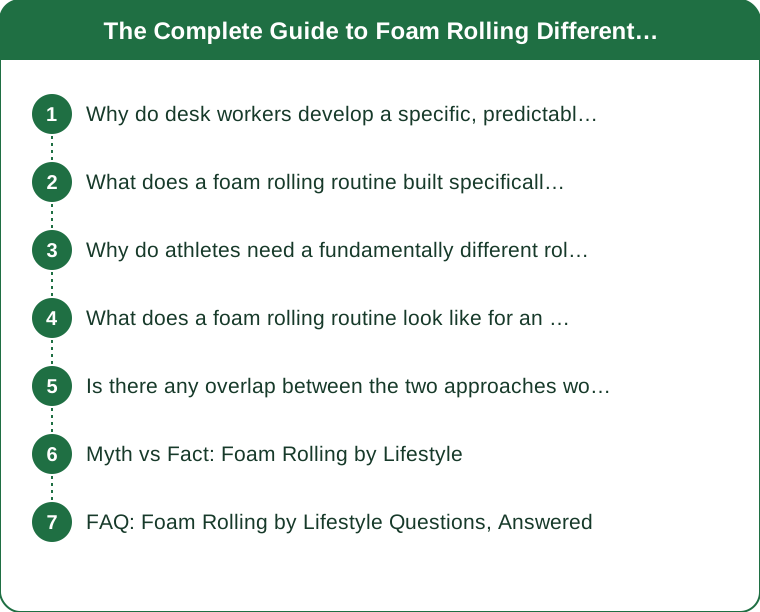
Why do desk workers develop a specific, predictable tightness pattern?
Prolonged sitting shortens the hip flexors while simultaneously lengthening and weakening the glutes, and forward-leaning posture over a keyboard tightens the chest and rounds the upper back, creating a consistent pattern across most desk-based lifestyles regardless of individual differences. This pattern is largely postural in origin, not related to specific muscle overuse from activity.
What does a foam rolling routine built specifically for that desk-worker pattern look like?
Prioritizing hip flexor rolling (using the roller under the front of the hip, controlled and slow), thoracic spine extension over the roller, and chest opening against a doorframe or roller targets the exact areas tightened by sitting posture. Ten minutes focused on these three areas, done most days, addresses the specific pattern more effectively than a generic full-body routine split thin across areas that aren’t actually tight.
Why do athletes need a fundamentally different rolling focus?
Athletic tightness comes from repeated muscle contraction and eccentric loading during training, concentrated in whatever muscle groups the specific sport uses most — quads and calves for runners, lats and shoulders for swimmers, hip adductors for lateral-movement sports. This tightness is activity-driven rather than postural, and it shifts based on training phase and volume.

What does a foam rolling routine look like for an athlete in a heavy training block?
Focusing rolling time on the primary muscle groups stressed by that week’s training — quads and IT band during a heavy running week, lats and rear delts during a heavy swimming or pulling week — matches the rolling routine to the actual tissue stress rather than rolling generically. Rolling immediately post-training, while tissue is warm, is also more commonly recommended for athletes managing acute training stress.
Is there any overlap between the two approaches worth keeping in both routines?
Yes — calves and the upper back tend to tighten in both populations, for different underlying reasons (sitting posture versus training load), so these two areas are reasonable to include regardless of which category you fall into, while the rest of the routine should diverge based on your actual daily tightness pattern.
Myth vs Fact: Foam Rolling by Lifestyle
Myth: One general foam rolling routine works equally well for everyone. Fact: Desk-based postural tightness and athletic training-related tightness are different problems requiring different focus areas.
Myth: Athletes don’t need to worry about postural tightness from sitting. Fact: Many athletes also have desk jobs and can develop the same postural tightness pattern on top of training-related tightness.
Myth: More total rolling time is always better regardless of focus. Fact: Focused rolling on the actual tight areas for your lifestyle is more effective than spreading the same time thin across a generic full-body routine.
FAQ: Foam Rolling by Lifestyle Questions, Answered
What if I’m both a desk worker and a serious athlete?
Combining a shorter version of both routines — hip flexors and thoracic spine for posture, plus your sport’s primary muscle groups — is reasonable, prioritizing whichever tightness feels more limiting on a given day.
How long before a lifestyle-specific routine shows noticeable improvement?
Most people notice reduced stiffness in the targeted areas within 1-2 weeks of consistent, focused rolling, faster than a generic routine often produces.
Should the routine change based on training phase for athletes specifically?
Yes — shifting rolling focus to match whatever muscle groups are under the heaviest load that training block keeps the routine relevant rather than static year-round.
TL;DR:
- Desk workers develop a predictable postural tightness pattern: hip flexors, chest, upper back
- Athletes develop activity-driven tightness concentrated in their sport’s primary muscle groups
- Calves and upper back tightness overlap in both groups, for different underlying reasons
- Focused, lifestyle-specific rolling outperforms a generic full-body routine spread thin
If foam rolling hasn’t felt like it’s addressing your actual tightness, the routine — not the tool — is probably the mismatch. Match it to your day, not a generic template.
Keep Reading
This article is for general informational purposes only and is not medical advice. Always consult a qualified health professional for guidance specific to you.