The Complete Guide to Rolling and Releasing When You Are Travelling Without a Roller
Quick Answer: A foam roller is a pressure delivery device, and pressure can come from many things - a tennis ball, a rolled towel, a water bottle, a door frame, your own hands, or simply moving the joint through range. Travel weeks are also when you need it most, because sitting for hours in a plane or car does more to your hips and upper back than a normal week does. Pack one tennis ball, learn four floor positions and two standing ones, and you can cover the whole body in eight minutes.
You packed for the week and left the roller at home, obviously.
The roller was never the point. The pressure was.
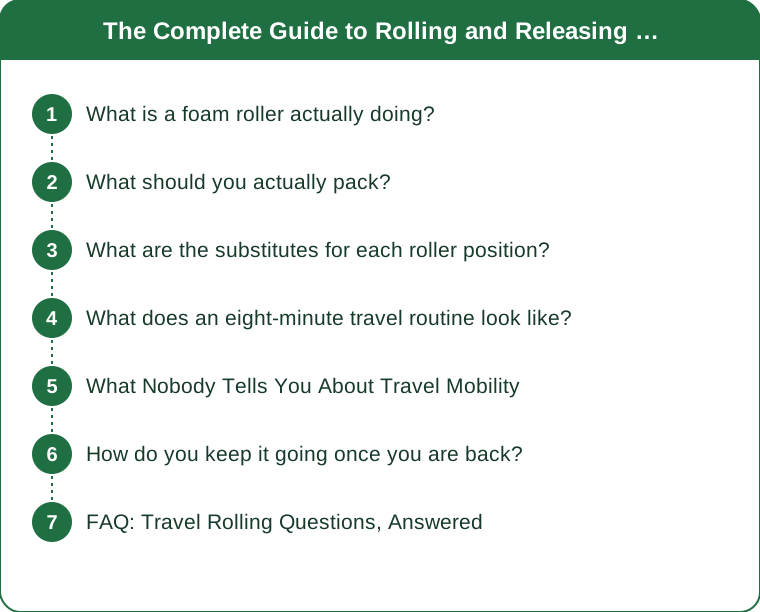
What is a foam roller actually doing?
It applies sustained pressure to soft tissue while you control how much load goes into it, using body weight as the force source.
The commonly reported effects are a short-term increase in range of motion and a reduction in perceived tightness, with the evidence generally stronger for range of motion than for anything structural.
Much of the effect is likely neural rather than mechanical. Sustained pressure and the associated discomfort tolerance appear to change how much range the nervous system permits, rather than physically lengthening tissue.
Which is why breathing matters as much as pressure. A slow exhale during a held position does more than pushing harder.
And it is why the specific implement matters far less than people assume. Anything that delivers controlled sustained pressure to the right place does substantially the same job.
The one thing a roller does uniquely well is cover large areas fast - quads, upper back, lats. Small targets are actually better served by a ball, which travels far more easily.
So the travel question is not how to replace a roller. It is how to deliver pressure and range work with what you have.
What should you actually pack?
One tennis ball or lacrosse ball. This is the highest-value item by an enormous margin - it weighs nothing, costs little, and covers glutes, feet, upper back, pecs and calves.
A lacrosse ball is firmer and more targeted; a tennis ball is gentler and better if you are new to it or travelling somewhere with hard floors.
Two balls in a sock makes a peanut shape for either side of the spine, which is the single most useful upper-back tool and packs completely flat.
A resistance band if you have room, which covers the range-of-motion half of the job that a ball cannot.
Nothing else is necessary. Travel rollers exist and they work, but the ball plus band combination covers more with a fraction of the volume.
Check the floor situation on arrival. Hard hotel floors change the sensation considerably compared with a carpeted room or a mat at home, and you may want less pressure than usual for the first session.
And plan for a towel, which every room has and which substitutes for several things below.
What are the substitutes for each roller position?
Quads: use a rolled towel on the floor, or skip the rolling and do a half-kneeling hip flexor position instead - for most travellers the hip flexors are the actual problem after a long flight, not the quads. A tightly rolled bath towel gives roughly the diameter of a small roller and enough firmness to be useful, and unlike a roller it will not slide out from under you on a hard floor.
Upper back: two balls in a sock, lying on your back with the sock either side of the spine, knees bent, moving slowly. This is better than a roller for the thoracic spine, not worse, because the balls sit either side of the spinous processes rather than pressing directly on them. Pause where it feels dense and take three slow breaths rather than rolling continuously.
Glutes: single ball, seated on the floor, ankle crossed over the opposite knee, leaning into the side you are working. The most effective travel position on the list, and the one that addresses the largest single consequence of a long flight or drive. Lean gradually rather than dropping your weight onto it.
Calves: single ball while seated, with the other leg stacked on top for extra pressure. A water bottle also works if it is firm and unopened, and an unopened bottle is more comfortable than a roller for anyone who finds calf work unpleasant.
Feet: a ball underfoot while standing at the bathroom counter, which takes ninety seconds and does more for a day of walking than most things. Use the counter for balance so you can control exactly how much weight goes through it, and work from heel to toes in slow passes.
Lats: ball against the wall, arm raised, leaning sideways into it. Standing wall work is generally more travel-friendly than floor work, because it requires no floor space, no cleanliness assumptions and no getting up and down.
Pecs and front shoulder: ball against a wall or a door frame, which is where a week of laptop work in a bad chair actually accumulates. The door frame is better than the wall here because the edge lets you angle into the front of the shoulder rather than flattening across the chest.
And hamstrings: a firm chair edge, seated with the leg extended, sliding slowly. Hotel desk chairs work well for this, and it is one of the few positions that is genuinely easier away from home than with a roller.
What does an eight-minute travel routine look like?
Minute one to two: feet. One ball, ninety seconds each side, standing at a counter. Do this first because it changes everything above it - foot tissue work has a measurable short-term effect on hamstring and posterior chain range, which makes everything that follows more productive.
Minute two to four: glutes. Seated ball work, ninety seconds each side, breathing out on each hold. This is the position to prioritise if the day involved a long flight or a long drive.
Minute four to six: upper back with two balls in a sock, moving slowly from the mid-back upward, pausing where it feels dense. Keep the ribs down rather than arching over the balls, which turns a thoracic position into a lumbar one.
Minute six to seven: pecs and front shoulder against the wall or door frame, thirty seconds each side. This is the one people skip and the one that most directly addresses a week of hunching over a laptop in a hotel chair.
Minute seven to eight: a half-kneeling hip flexor position, thirty seconds each side, which addresses the largest single consequence of sitting for hours.
Do it in the evening rather than the morning on travel days - the tissue has taken the load by then, and the routine also helps you settle in an unfamiliar room.
Add ninety seconds of thoracic rotations if you have time, which is a range-of-motion addition rather than a pressure one and complements everything above it.
And on the day you fly or drive, do the feet and hip flexors at minimum, even if you skip everything else. Those two cover most of the actual cost of a travel day, and doing two positions reliably beats planning eight and doing none.
What Nobody Tells You About Travel Mobility
Travel weeks are when this work matters most and when people drop it entirely. Long-haul sitting, unfamiliar beds, heavy bags on one shoulder and a week of walking in different shoes represent a bigger load change than most training blocks. Dropping the routine in exactly the week the input changed is backwards.
A hotel bed does more to your back than the flight did, for many people. Unfamiliar mattress firmness is one of the most common causes of travel back stiffness and it is entirely absent from the usual advice about compression socks and aisle seats.
Walking beats rolling on travel days. If you can only do one thing after a long flight, a twenty-minute walk outperforms any amount of floor work for stiffness and for adjusting to the new time zone.
Hard floors change the dose substantially. The same ball on a tiled hotel floor delivers noticeably more pressure than on carpet or a mat at home, and people routinely overdo the first session and then feel bruised for two days.
The bathroom counter and the door frame are the two most useful pieces of equipment in any hotel room, and neither appears in a single travel fitness article. Standing wall and frame work is easier to actually do than getting on an unfamiliar floor.
A ball in the carry-on has never been a problem at security, and it doubles as the thing you use in the airport before boarding - a few minutes of foot work at the gate is more useful than the same work after landing.
And the routine you can do in a small space beats the routine you would prefer. Eight minutes beside a hotel bed done six times in a week is worth far more than a perfect forty-minute session you do once you get home.
How do you keep it going once you are back?
Do the travel routine on the first day home rather than jumping straight back to the full version - the travel load is still in your system.
Keep the ball in your bag permanently. The whole reason travel routines fail is that packing them is a decision; leaving them packed removes it.
Note which areas felt worst during the trip, since that is genuinely useful information about your normal setup, not just about the trip.
Do not compensate with a longer session. More pressure on tissue that has had a hard week is not a productive trade.
Resume normal training gradually if you missed sessions, especially after a week of unusual walking volume in unfamiliar shoes.
And if something hurt during travel and still hurts several days after returning, see a professional. Persistent pain is a different category from travel stiffness. This is general information, not medical advice.
FAQ: Travel Rolling Questions, Answered
Can a tennis ball really replace a foam roller?
For most purposes yes, and for small targets - glutes, feet, upper back, pecs - it is better. The roller’s advantage is covering large areas quickly, which matters less on a short travel routine.
What can I use if I have no ball at all?
A rolled towel, a firm water bottle, a door frame and a chair edge cover most positions. Standing wall work needs no equipment beyond the wall.
Should I roll before or after a flight?
After, along with a walk. Before a flight, the more useful thing is simply walking the terminal rather than sitting at the gate.
Why does the same routine feel more intense in a hotel?
Hard floors deliver more pressure than a mat or carpet. Reduce the dose for the first session in a new place.
How long should I hold each position?
Thirty to ninety seconds per area, breathing out slowly during the hold. Longer with less pressure generally beats shorter with more.
Is it bad to skip it entirely for a week?
No lasting harm, but travel weeks change the load on your body more than ordinary weeks do, which is exactly why a short routine is worth more then than usual. This is general information, not medical advice.
TL;DR:
- A roller is a pressure delivery device; a single tennis ball reproduces most of what it does.
- Two balls in a sock beats a roller for the thoracic spine and packs flat.
- The bathroom counter, the wall and the door frame are the most useful hotel-room equipment.
- An eight-minute routine covering feet, glutes, upper back, pecs and hip flexors is enough.
- Hard hotel floors deliver more pressure than home surfaces - reduce the first session.
- On travel days, a twenty-minute walk outperforms any amount of floor work.
Keep the ball permanently in the bag so packing it stops being a decision. This is general information, not medical advice.
Keep Reading
This article is for general informational purposes only and is not medical advice. Always consult a qualified health professional for guidance specific to you.