The Complete Guide to Foam Rolling When You Only Have Five Minutes
Quick Answer: In five minutes you can cover two or three areas properly or eight areas uselessly. The research on foam rolling suggests roughly 30 to 120 seconds per area produces the range-of-motion benefit, which means a five-minute session realistically holds two to four regions. Choose them based on what you did today and what you are about to do - not on a fixed full-body sequence. Depth and dwell time beat coverage every single time. Five focused minutes beats fifteen distracted ones.
The full-body routine is the reason most people quit.
A short honest routine you actually do is worth more than a long one you skip.

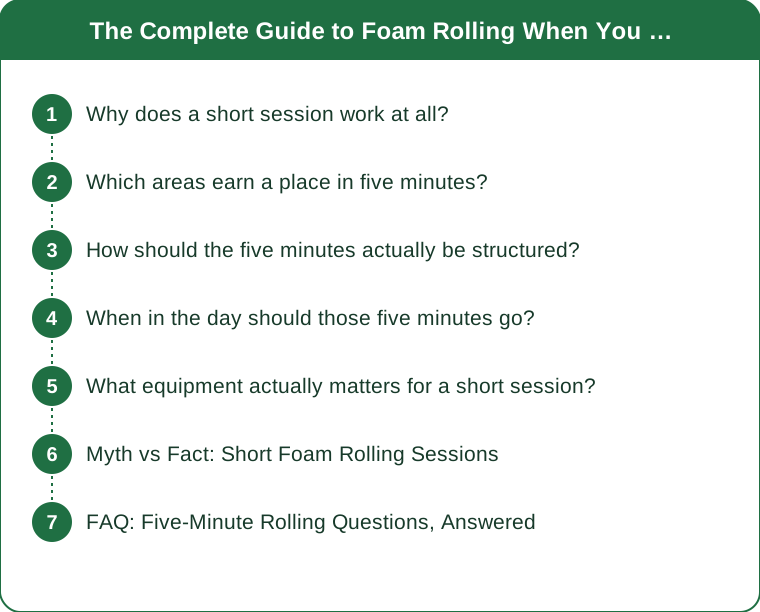
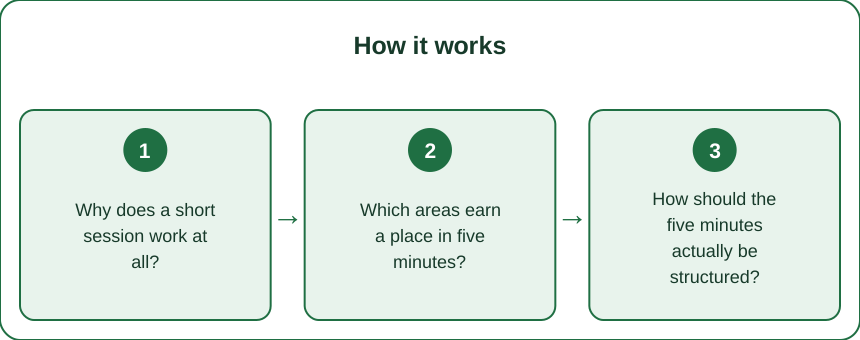
Why does a short session work at all?
Because the mechanism is largely neural, and neural changes happen fast.
The old explanation - that you are breaking up adhesions or reshaping fascia - does not hold up well. The forces a person can generate with body weight on a foam roller are far below what would be needed to deform dense connective tissue, and the effects wear off within an hour or so, which is not how structural change behaves.
The better-supported explanation is a nervous system response. Sustained pressure appears to reduce the stretch reflex sensitivity and raise pain tolerance in the area, both of which show up quickly and both of which increase available range of motion. That is why a minute can matter.
Studies consistently find range-of-motion gains from short bouts. Commonly used protocols in the literature run 30 to 120 seconds per muscle group, and improvements in joint range show up reliably in that window. Longer sessions have not clearly demonstrated proportionally better results.
Crucially, the effect is temporary. Range-of-motion improvements typically fade within about 10 to 20 minutes to an hour, which means the timing of your five minutes matters more than the duration. Rolling at 8am for a 6pm workout accomplishes very little for that workout.
And the performance question is settled enough to act on. Foam rolling before training does not appear to reduce strength or power output the way long static stretching can, which makes it a safe pre-training option.
The practical consequence: a short, well-timed session captures most of the available benefit. The twenty-minute full-body routine is not five times better than four focused minutes - it is mostly more of something with diminishing returns.
Which areas earn a place in five minutes?
Pick by what you did and what you are about to do, not by a template.
If you sit all day and are about to train: hip flexors, thoracic spine, glutes. Prolonged sitting shortens the front of the hip and stiffens the mid-back, and both directly limit squatting, hinging, and overhead work. Ninety seconds each and you have used your five minutes well.
If you ran today: calves, quads, glutes. These take the bulk of running load, and calves in particular respond noticeably. Skip the IT band - see below.
If you lifted lower body: quads, adductors, glutes. The adductors are the commonly skipped one and are frequently the most sensitive, which usually indicates they have been working.
If your back is the complaint: glutes and thoracic spine, not the lower back. Rolling directly on the lumbar spine is generally advised against because there is no rib cage protection and the spinal muscles there tend to guard rather than relax. Address what is above and below it.
If you are stiff everywhere and cannot choose: thoracic spine, glutes, calves. These three cover the most functional territory per minute for a general-purpose session and are the default worth memorising.
What consistently does not earn a spot: the IT band directly. The IT band is dense connective tissue that does not meaningfully deform under a roller, and rolling it hard is mostly a pain experience. The muscles that tension it - tensor fasciae latae and glutes - are the useful targets.
And skip anything that is currently painful in a sharp or nerve-like way. That is not a foam roller problem.
How should the five minutes actually be structured?
One timer, two to four blocks, no wandering.
Set a timer before you start. Without one, most people spend three minutes on the first spot and thirty seconds on everything else, because the first spot is the one that hurts. The timer is the entire discipline of a short session.
Give each area 60 to 90 seconds. That lands inside the range used in the research and fits three areas comfortably into five minutes with transitions.
Move slowly - roughly one inch per second. Fast rolling back and forth is the most common error and it does not give the nervous system time to respond. A single slow pass down a quad takes 20 to 30 seconds on its own.
When you find a tender spot, pause on it for 20 to 30 seconds and breathe. Sustained pressure with relaxed breathing does more than repeated passes, and holding your breath actively works against the response you want.
Keep the muscle relaxed. A braced, tensed muscle under a roller is defending itself. If you are gripping the floor and clenching your jaw, the pressure is too high - reduce load by supporting more weight on your hands or the opposite leg.
Combine movement with pressure for a bigger effect. Rolling the quad while slowly bending and straightening the knee adds an active component that several protocols favour. Same for the calf with ankle circles.
Finish by moving the joint you just worked on. Ten slow squats after rolling quads and hips, or ten shoulder circles after thoracic work, uses the range you just created. Range that is not used tends to fade faster.

When in the day should those five minutes go?
As close to training as possible - and the second-best slot is not the one people pick.
Before training is the highest-value slot. The range-of-motion improvement lasts long enough to affect the session and does not blunt strength output, unlike long static stretching. Five minutes of rolling plus a proper warm-up is a sensible pre-training block.
After training is the second-best, and for a different reason. The evidence on foam rolling reducing delayed-onset muscle soreness is modest but reasonably consistent - the effect sizes are small and the practice is low cost. Post-session rolling also fits more reliably into a schedule.
First thing in the morning is the least effective slot for a training benefit and possibly the best for adherence. The range gains will be gone by the afternoon, but a routine you do daily at 7am beats one you skip at 6pm. Be honest about which problem you are solving.
Before bed serves relaxation rather than range. Slow rolling with long holds and slow breathing has a calming quality that many people find genuinely useful, whatever the mechanism. That is a legitimate use of five minutes.
Avoid rolling hard immediately before a maximal effort. The evidence says it does not hurt performance, but a very aggressive session leaves the area feeling odd, and that is not what you want two minutes before a heavy lift.
And there is a temperature note worth knowing. Tissue rolls very differently when warm - after a shower or ten minutes of walking, the same pressure feels considerably less intense. In cooler autumn weather this becomes noticeable: the same routine that felt fine in August feels harsher in October, and a few minutes of movement first fixes it.
What equipment actually matters for a short session?
Less than the market suggests, with two exceptions.
Density matters more than any other feature. A soft roller is appropriate when you are new or very sensitive; a firm one delivers more pressure for the same body weight. Most people progress from soft to firm over a few months and then stay there.
Textured rollers concentrate pressure into smaller points. That is more intense, not more effective by default. For a five-minute session where you want to relax rather than brace, a smooth firm roller is usually the better tool.
Length is a real practical consideration. A full-length roller is required if you want to lie on it lengthwise for thoracic and chest work; a short travel roller cannot do that. If you buy one roller, buy a long one.
A massage ball is the highest-value second purchase. Glutes, feet, and the area around the shoulder blade are all reached far better by a ball than a roller, and a ball takes no storage space. A lacrosse ball costs a few dollars and does most of it.
Vibrating rollers exist and the evidence is mixed. Some studies show slightly larger range-of-motion improvements with vibration, others show no meaningful difference. They cost several times more. Not the place to spend money first.
And where you roll matters more than most people think. A hard floor transmits your full body weight; a carpet or mat absorbs some of it. If a session feels suddenly harsher or gentler than usual, check the surface before concluding anything about your body.
One thing that genuinely helps and costs nothing: keep the roller visible. A roller in a cupboard gets used a fraction as often as a roller beside the sofa. For a five-minute habit, friction is the whole game.
Myth vs Fact: Short Foam Rolling Sessions
Myth: Five minutes is not long enough to do anything. Fact: Protocols in the research commonly use 30 to 120 seconds per area. Five focused minutes covers two to four areas at research-supported durations. The problem with short sessions is spreading them too thin, not the total time.
Myth: It hurts because you need it. Fact: Sensitivity varies by tissue type, recent training, hydration, sleep, and time of day. The most tender spot is not automatically the most important one, and pain intensity is a poor guide to what to prioritise.
Myth: You are breaking up scar tissue and adhesions. Fact: The forces involved are well below what would restructure dense connective tissue, and the effects fade within an hour - which is not how structural change works. The mechanism appears to be largely neural.
Myth: Rolling before lifting makes you weaker. Fact: Unlike prolonged static stretching, foam rolling has not been shown to reduce strength or power output. It is a safe pre-training choice.
Myth: More pressure is better. Fact: Pressure high enough to make you tense and hold your breath works against the relaxation response you are trying to produce. Aim for a 5 or 6 out of 10, where you can still breathe normally.
Myth: You should roll every muscle every session. Fact: Full-body coverage in a short session means 30 seconds of nothing per area. Two or three areas done properly is the higher-value trade.
FAQ: Five-Minute Rolling Questions, Answered
How many days a week should I do five minutes?
Daily is fine and safe. There is no accumulation requiring rest days the way there is with training. Consistency matters more than session length - four short sessions a week beats one long one.
Should it hurt?
It should be uncomfortable but tolerable - around a 5 or 6 out of 10, where your breathing stays normal. Sharp, electric, or radiating sensations are a signal to move off that spot, not to push through. If something hurts consistently and sharply, see a professional. This is general information, not medical advice.
Can I just use a massage gun instead in the same time?
For a short session, largely yes. The available comparisons suggest broadly similar acute range-of-motion effects, and a gun is faster for targeted spots. A roller does thoracic extension and large surfaces better. Use whichever one you will actually pick up.
TL;DR:
- Five minutes holds two to four areas at 60 to 90 seconds each - the durations used in the research.
- Choose areas by what you did today and what you are about to do, not by a full-body template.
- Move about an inch per second and pause 20 to 30 seconds on tender spots, breathing normally.
- The effect is largely neural and fades within an hour, so timing near training matters more than duration.
- Skip the IT band directly and skip the lower back; roll the glutes and thoracic spine instead.
Set a three-area timer tonight and leave the roller where you will trip over it. That is the whole routine.
Keep Reading
This article is for general informational purposes only and is not medical advice. Always consult a qualified health professional for guidance specific to you.