The Complete Guide to Rolling Your Upper Back and What It Frees Up Overhead
Quick Answer: Rolling your thoracic spine — the section between your shoulder blades — for one to two minutes reliably improves overhead reach, standing posture, and how deep you can breathe, because it restores extension in the one part of your spine built to extend. The technique matters more than the time: roller across the back, hips down, hands supporting your head, moving slowly through the stiff zone rather than sprinting the whole spine. And like all rolling, the change is temporary unless you immediately use the new range.
This guide covers what the upper back controls, how to roll it properly, and how to keep what you gain.

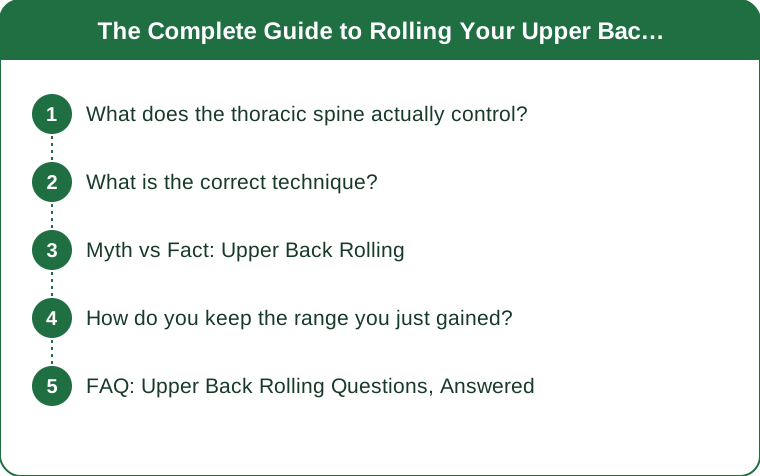
What does the thoracic spine actually control?
Far more than the space between your shoulder blades. It is the platform your shoulders and neck work from.
Your spine has regions with different jobs. The lower back is built for stability, the neck for fine positioning, and the thoracic spine — the twelve segments your ribs attach to — is where most of your rotation and a critical amount of extension are supposed to come from.
When the thoracic spine stiffens into a rounded position, the demand does not disappear. It relocates.
Reach overhead with a stiff upper back and the missing extension gets borrowed from your lower back, which arches, and your shoulder, which gets asked for range at an angle it does not have. This is why so much shoulder pinching during presses and pull-ups traces back to a spine problem two feet below the symptom.
Sit through a workday and the thoracic spine settles into flexion — rounded forward — for hours at a stretch. The tissue does not shorten permanently in a day, but the nervous system gets very comfortable defending that shape, and extension starts to feel unfamiliar and effortful.
Breathing is the third casualty. Your ribs hinge on the thoracic segments, and a flexed, stiff mid-back limits how well the ribcage expands. People who roll their upper back for the first time often report the deep-breath effect before they notice the posture effect.
The roller works here for the same reason it works elsewhere: pressure and slow movement give the nervous system a strong input, and it responds by releasing its grip on the range it was defending. The upper back is arguably the single highest-return place on the body to apply that, because the region is designed to move and modern life keeps it still.
What is the correct technique?
More specific than lying on the thing and rocking. Position determines whether you get extension or just pressure.
Setup. Roller on the floor, perpendicular to your spine. Lie back over it so it sits at the bottom of your shoulder blades. Feet flat, knees bent, hips on the floor. Hands behind your head — not pulling, just supporting the weight of your skull so your neck can relax.
Hips stay down. This is the detail that separates a thoracic mobilization from a lower-back arch. With hips lifted, the movement happens wherever your body finds it easiest, which is usually the lower back — the exact region you do not want extending more. Hips on the floor forces the hinge to happen at the roller.
Extend, do not just roll. The productive movement is draping backward over the roller — letting your upper back arch over it for a breath or two — then returning up. Do that two or three times at one level, then move the roller one segment and repeat. Slow drapes at four or five spots beat thirty fast passes up and down.
Cover from the bottom of the shoulder blades to the top, and stop there. The roller should not go onto your neck, and it should not migrate down onto the lower back, which is a region that needs stability rather than pressure.
Breathe out as you extend. The exhale drops your ribcage and lets the segment move further with less guarding. Holding your breath stiffens everything and works against the mechanism.
One practical note on clothing: roll in something smooth. A sports bra clasp, a hood, or a back zipper sits directly between your spine and the roller, and a seamless tank or a smooth-backed top makes the whole thing more comfortable — the same reason seamless leggings beat pocketed joggers for any floor work.
Total time: one to two minutes. More is fine and mostly unnecessary.

Myth vs Fact: Upper Back Rolling
Myth: the cracks and pops mean it worked. Fact: cavitation sounds are gas shifting in joints and correlate poorly with meaningful change. A session with no pops can free up more range than a noisy one. Judge by the retest, not the soundtrack.
Myth: rolling fixes posture. Fact: rolling opens a window; it does not hold you upright. Posture through the day is a motor habit and an endurance question. The roller makes the tall position cheaper to access — using it is still your job.
Myth: harder pressure works better. Fact: past a moderate threshold, extra pressure just triggers guarding. If you are bracing, wincing, or holding your breath, the nervous system is defending, not releasing. A standard-density roller is plenty for the upper back.
Myth: you should roll the lower back the same way. Fact: the lumbar spine has no rib cage support, wants stability, and generally responds poorly to direct extension over a roller. Stop the roller at the bottom of the ribs. If your lower back feels tight, the answer is usually hips and thoracic work, not lumbar pressure.
Myth: a vibrating or knobbled roller changes the result. Fact: no good evidence of a meaningful difference. Texture changes the sensation, not the adaptation. Buy whichever one you will actually use.
Myth: it only matters for lifters. Fact: the people with the stiffest thoracic spines are usually the ones who sit most, not the ones who train most. The overhead test below is worth running on any desk worker.
How do you keep the range you just gained?
By loading it within a few minutes, because a neural change unused is a neural change returned.
First, prove the change to yourself. Before rolling, stand with your back against a wall, heels a few inches out, and slide your arms up overhead like a snow angel, keeping your ribs down. Note where your wrists stop or peel off the wall. Roll for ninety seconds, retest. Most desk workers see an obvious difference on the first try — higher reach, or the same reach with far less strain in the shoulders.
Then spend the window. Three options, in order of usefulness:
Load it overhead. A few sets of anything that takes the arms up under control — dumbbell presses, a light barbell press, or even slow wall slides with a pause at the top. Loading tells the nervous system the new range is safe and worth keeping.
Rotate through it. Open-book stretches or thread-the-needle done immediately after rolling reach noticeably further than they do cold, and rotation is half of what the thoracic spine is for.
Breathe into it. A minute of slow, full breaths lying flat, letting the ribcage expand in every direction. This is the low-effort option for days you are not training.
The weekly structure that works: roll before any upper body session and use the first exercises to occupy the range. On desk days, ninety seconds in the evening followed by wall slides. The version that fails is rolling and then sitting straight back down at the laptop — which, not coincidentally, is the most popular version.
This is general information, not medical advice. Numbness, tingling down the arms, or sharp localized spine pain during rolling are reasons to stop and get assessed, not to press harder.
FAQ: Upper Back Rolling Questions, Answered
How often should I do it?
Daily is fine and unnecessary. Before upper body training plus evenings after long desk days covers the meaningful benefit. Consistency across weeks matters more than minutes per session.
Roller or peanut ball for the upper back?
Start with the roller — it distributes pressure and mobilizes the region broadly. A peanut or double ball targets single segments and is a useful upgrade once the general work stops finding stiff spots.
Why does one spot always feel stiffer than the rest?
Almost everyone has a zone around the middle of the shoulder blades that moves least, because it is the apex of the seated slump. That spot deserves the extra drape or two. If one spot is sharply painful rather than stiff, work around it and get it looked at if it persists.
Can I use a rolled towel or a bed instead?
A firm rolled towel on the floor works as a gentler version and is a good travel substitute. A bed is too soft to create the fulcrum — the floor is doing half the work.
TL;DR:
- The thoracic spine is where overhead reach, rotation, and rib expansion come from, and desk life parks it in flexion.
- Technique: roller across the upper back, hips down, head supported, slow backward drapes at four or five levels, exhaling into each.
- Stop at the bottom of the ribs — the lower back wants stability, not extension over a cylinder.
- The change is neural and temporary: retest against a wall, then spend the window on presses, rotations, or full breaths.
Run the wall test tonight, roll for ninety seconds, and test again. The difference between the two attempts is the entire argument.
Keep Reading
This article is for general informational purposes only and is not medical advice. Always consult a qualified health professional for guidance specific to you.