Why Foam Rolling Hurts So Much More in Certain Spots (and What That Actually Means)
Quick Answer: Foam rolling hurts more in specific spots because of localized trigger points — small areas of tight, irritated muscle fiber — not because something is wrong or because you’re rolling incorrectly everywhere else.
You roll your quad and it’s mostly fine, then you hit one spot on your IT band and you’re gripping the mat trying not to yell. That contrast is actually diagnostic information.

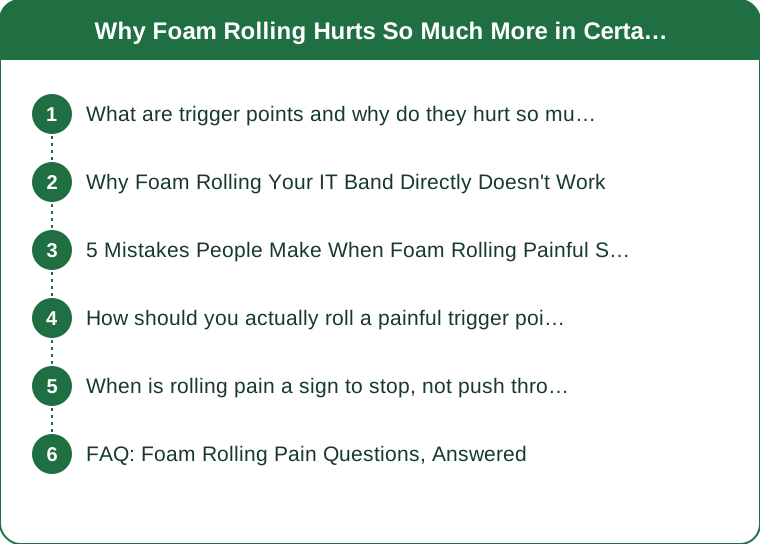
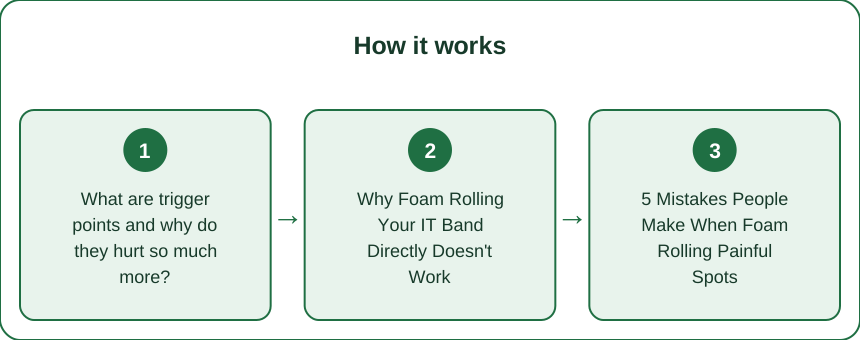
What are trigger points and why do they hurt so much more?
A trigger point is a small area of muscle fiber that’s stayed contracted and irritated, often from overuse, poor movement patterns, or prolonged sitting. Rolling directly over one applies concentrated pressure to already-sensitized tissue, which is why the pain feels disproportionate to the same pressure applied nearby.
This is a normal, common finding — most active people have several trigger points at any given time, and finding one under the roller isn’t a sign of serious injury on its own.
Why Foam Rolling Your IT Band Directly Doesn’t Work
The IT band itself is a thick, mostly non-contractile band of connective tissue — it doesn’t respond to pressure the way muscle does, and rolling it directly is often just painful without providing much release. The muscles surrounding it (the quad and the outer hip, specifically the TFL and glute med) are usually where the actual tightness driving IT band pain lives.
Try rolling the quad and outer hip muscles around the IT band instead of grinding directly on the band itself — you’ll likely find the same relief with far less unnecessary pain.
5 Mistakes People Make When Foam Rolling Painful Spots
- Grinding hard and fast over a painful spot instead of slowing down and easing in
- Holding full body weight on the roller at a trigger point instead of controlling pressure with your limbs
- Rolling a truly injured area (sharp, localized pain) the same as a normal tight spot
- Skipping breathing — holding your breath through pain increases muscle guarding and makes it feel worse
- Rolling only once and expecting immediate release, instead of sustained gentle pressure over 20-30 seconds

How should you actually roll a painful trigger point?
Find the spot, then stop and hold — sustained pressure for 20-30 seconds is more effective than repeatedly rolling back and forth over it. Breathe slowly and let the muscle relax into the pressure rather than tensing against it.
Start with body weight partially supported by your hands or the opposite leg, and only add full weight gradually as the spot becomes more tolerable across sessions — pain should decrease noticeably session over session, not stay constant.
When is rolling pain a sign to stop, not push through?
Sharp, shooting, or numbing pain — as opposed to a dull, achy ‘hurts so good’ sensation — is a signal to stop and reassess, since it can indicate nerve involvement rather than a normal muscular trigger point. Bruising, swelling, or pain that gets worse day over day instead of better also warrants backing off and possibly seeing a professional.
Normal trigger point discomfort should ease within the same session and improve session over session over 1-2 weeks of consistent, gentle work.
FAQ: Foam Rolling Pain Questions, Answered
Is it normal for foam rolling to be this painful?
Moderate discomfort at trigger points is common and normal; sharp or worsening pain over days is not and should be evaluated by a professional.
How long until a painful spot stops hurting as much?
Most people notice a meaningful reduction in tenderness within 1-2 weeks of consistent, gentle rolling, though some spots take longer depending on how long the tightness has built up.
Should I roll a spot that’s actually injured, not just tight?
No — an acute injury needs rest and possibly professional evaluation, not direct pressure, which can aggravate it further.
TL;DR:
- Painful spots under the roller are usually trigger points, not something wrong
- The IT band itself doesn’t respond to direct rolling — target the muscles around it
- Hold pressure for 20-30 seconds instead of grinding back and forth
- Sharp or worsening pain means stop and consider a professional evaluation
This is general information, not medical advice — see a physical therapist if pain is sharp, spreading, or not improving after two weeks of gentle, consistent work.
Keep Reading
This article is for general informational purposes only and is not medical advice. Always consult a qualified health professional for guidance specific to you.