Why Foam Rolling Your IT Band Directly Doesn't Actually Work
Quick Answer: The IT band is a thick band of connective tissue, not a muscle, so foam rolling it directly doesn’t lengthen or ‘release’ it the way people assume — the real benefit comes from rolling the muscles attached to it (glutes and outer quad), which the IT band responds to indirectly.
You’ve rolled your outer thigh until it hurt, convinced you were ‘releasing’ a tight IT band, and felt some temporary relief — but the mechanism behind that relief isn’t what most people think it is, and understanding it changes where you should actually spend your rolling time.

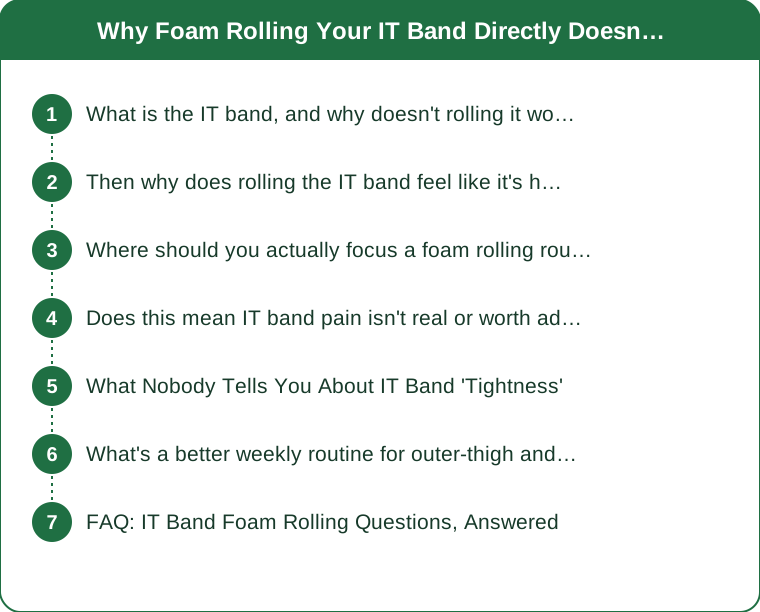
What is the IT band, and why doesn’t rolling it work the way people think?
The iliotibial (IT) band is a thick, fibrous band of connective tissue running from your hip to just below your knee — it’s structurally similar to a very thick tendon, not a contractile muscle. Muscle tissue responds to pressure by relaxing and lengthening; dense connective tissue like the IT band essentially doesn’t, no matter how much pressure or time you apply.
Research on this has found the IT band requires an enormous, non-physiological amount of force to actually deform even slightly, which is far more than a body-weight foam roller can generate.
Then why does rolling the IT band feel like it’s helping?
The temporary relief most people feel comes from rolling the muscles that attach to and pull on the IT band — primarily the tensor fasciae latae (TFL) at the hip and the glute muscles — rather than the band itself. Those are contractile tissues that genuinely do respond to pressure with reduced tension, and since they’re right next to where you’re rolling, the relief gets misattributed to the band.
The pain itself when rolling the IT band directly is also largely just pressure on a taut, low-cushion area over bone, not evidence of ‘release’ happening.
Where should you actually focus a foam rolling routine for outer-thigh tightness?
Spend your time on the glute muscles (especially glute medius) and the TFL at the front of your hip, both of which genuinely respond to foam rolling with reduced tension and improved mobility. These muscles directly influence how much tension gets transmitted through the IT band during activities like running or squatting.
Rolling the outer quad (vastus lateralis) also helps, since tightness there contributes to the sensation of a ‘tight IT band’ even though it’s a separate muscle entirely.

Does this mean IT band pain isn’t real or worth addressing?
IT band pain, especially IT band syndrome common in runners, is very real — it’s just usually driven by hip and glute weakness or imbalance rather than the band itself being ‘tight’ in a way rolling can fix. Strengthening glute medius specifically has much stronger research support for resolving IT band-related knee pain than any amount of direct rolling.
Rolling can still play a supporting role by reducing tension in the surrounding muscles, which is worth doing — just not as the primary fix.
What Nobody Tells You About IT Band ‘Tightness’
Most people experience a tight, painful feeling on the outer thigh and assume the band itself has shortened or tightened, but connective tissue like the IT band doesn’t change length the way a muscle does in response to activity or rolling. What actually happened is usually that surrounding muscles became tight or imbalanced, increasing the tension the band is under passively — the band is the messenger of the problem, not the source of it.
This is why people can roll their IT band painfully for months without lasting improvement, while a few weeks of targeted glute strengthening resolves the same symptoms much more reliably.
What’s a better weekly routine for outer-thigh and IT band-related discomfort?
Spend 2-3 minutes rolling glute medius and TFL per side, 3-4 times a week, followed by glute medius strengthening (side-lying leg raises, clamshells, or banded lateral walks) for 2-3 sets of 12-15 reps. This combination addresses both the temporary tension relief people seek from rolling and the actual root cause behind most IT band discomfort.
Most runners notice a meaningful reduction in outer-knee and hip tightness within 3-4 weeks of this combined approach, versus rolling the band directly with no strength component.
FAQ: IT Band Foam Rolling Questions, Answered
Is it harmful to foam roll the IT band directly if it feels good?
It’s not harmful for most people, but it’s not accomplishing what many assume — treat it as a minor comfort measure rather than the main fix, and prioritize glute and TFL work instead.
How long before glute strengthening improves IT band symptoms?
Most people report noticeable improvement within 3-4 weeks of consistent glute medius strengthening 2-3 times per week, though full resolution of chronic symptoms can take 6-8 weeks.
Should runners with IT band pain stop running entirely?
This depends on severity — mild tightness often doesn’t require a full stop, but sharp or worsening knee pain during runs is a signal to reduce mileage and consult a physical therapist rather than push through it.
TL;DR:
- The IT band is connective tissue, not muscle, so direct rolling doesn’t lengthen or ‘release’ it
- Relief from rolling the outer thigh actually comes from the glutes and TFL nearby
- Glute medius strengthening has much stronger evidence for resolving IT band pain than rolling
- Combine 2-3 minutes of glute/TFL rolling with strengthening work for the best results
The IT band isn’t the villain your foam roller made it out to be — it’s usually just carrying tension your glutes and hip muscles handed off to it.
Keep Reading
This article is for general informational purposes only and is not medical advice. Always consult a qualified health professional for guidance specific to you.