Why the Surface Under Your Foam Roller Changes Everything
Quick Answer: A soft surface lets the roller sink into the floor, which spreads your body weight across a wider contact patch and reduces peak pressure — often by a large margin. A hard floor concentrates the same weight into a narrower strip and feels dramatically more intense. If your rolling feels inconsistent week to week, the surface you are on is one of the most likely explanations, and it is a far easier variable to control than roller density.
People spend a lot of energy choosing between a soft roller and a firm one, a smooth one and a textured one. Almost nobody thinks about the thing on the other side of their body — the floor.
This is a mistake, because the floor is half of the compression system. Your tissue is being squeezed between two objects. Change either one and the pressure changes.
The practical result is that the same person, the same roller, and the same muscle can produce genuinely different sensations depending on whether they are on hardwood, a thick mat, carpet, or a hotel room rug. And because most people only ever roll in one place, they never notice — until they travel, or move, or roll at a gym, and conclude something has changed in their body.

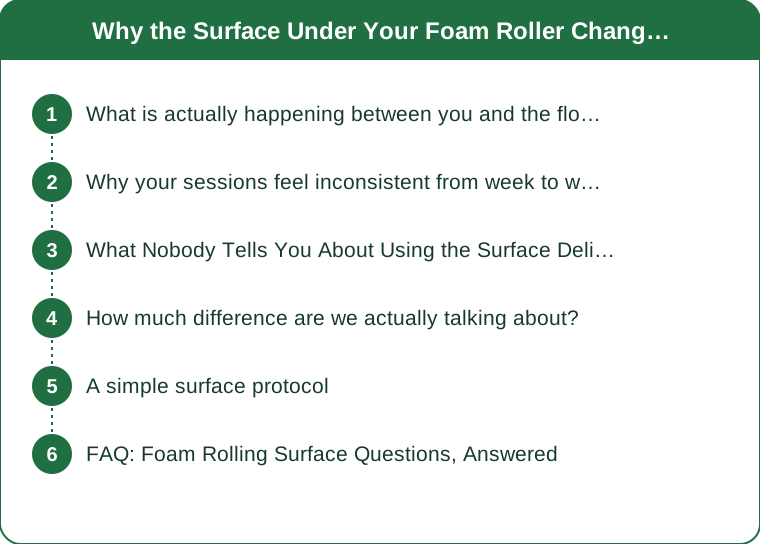
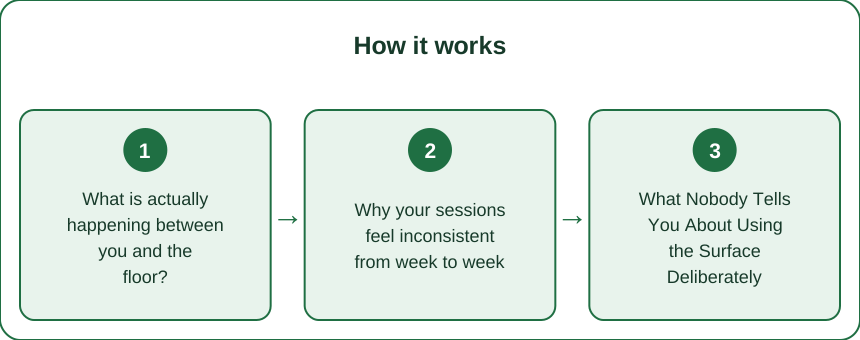
What is actually happening between you and the floor?
Compression is about pressure, and pressure is force divided by area. Your body weight is the force. The contact area is where the surface comes in.
On a hard floor, a cylindrical roller touches at essentially a line. The contact patch between your leg and the roller stays narrow, so all of the load you put through it concentrates into that narrow strip. This is why hardwood rolling feels sharp and specific, and why it produces that distinct sensation people describe as hitting the exact spot.
On carpet or a thick mat, the roller presses down into the surface. Two things happen at once: the roller sits partly below the surface plane, and the surface pushes back across a broader area. Your leg now wraps slightly more of the roller’s curve. The contact patch widens, peak pressure drops, and the sensation becomes broad and diffuse rather than pointed.
There is a third effect that gets missed. On a soft surface, some of the force you apply goes into deforming the floor instead of your tissue. You lose part of your input before it reaches the muscle. This is most noticeable when rolling on a bed or a very plush rug, where people often report that rolling feels like it is doing nothing at all — and functionally, it is not doing very much.
Firm roller on carpet and soft roller on hardwood can produce surprisingly similar sensations. That equivalence is useful, and it is the basis for everything below.
Why your sessions feel inconsistent from week to week
If you have ever thought a muscle was fine on Tuesday and unbearable on Saturday, check where you were.
Rolling in three different rooms is running three different protocols. The living room rug, the bedroom carpet, and the kitchen tile are not interchangeable, and the difference between them is often larger than the difference between a beginner roller and a firm one.
The gym adds another layer. Commercial gym flooring is usually rubber over concrete — firm, but with a few millimeters of give. That sits between hardwood and a yoga mat, which is why gym rolling frequently feels more intense than home rolling on carpet and less intense than rolling on bare tile.
Travel is where this becomes obvious. Hotel rooms are carpeted, often over concrete subfloor with a pad. People take a travel roller, roll on hotel carpet, feel almost nothing, and conclude the small roller is useless. Some of that is the roller. Much of it is that they went from a hard kitchen floor to a padded carpet without noticing.
The fix is not complicated: pick one surface and treat it as part of the protocol. If you want to compare sensation across weeks — which is the whole point of noticing what feels tight — you need the surface constant. Otherwise you are measuring the floor.
What Nobody Tells You About Using the Surface Deliberately
Once you understand the mechanism, the surface stops being an accident and becomes a dial.
Use a soft surface to make an intolerable area workable. The classic case is the IT band area or an especially reactive quad. Rather than buying a softer roller, put a folded blanket or a thick mat under the same roller. You get the same movement pattern at a lower peak pressure, and you can progress to a firmer surface over weeks. This is a cleaner progression than swapping rollers, because everything else stays identical.
Use a hard surface when you want specificity. For upper back work along the thoracic spine, or for a small stubborn area in the glute, the narrow contact patch of a hard floor is an advantage. You can actually find the spot instead of pressing broadly on everything nearby.
Match the surface to the muscle size. Large muscle groups tolerate — and generally benefit from — the broader contact of a slightly softer surface. Small, bony, or nerve-adjacent areas are usually better on firm ground with less body weight loaded, because you can control precisely how much you apply.
The bed is not a surface. Rolling on a mattress is close to pointless: the force disappears into the mattress, and the roller cannot stabilize. If a bed is the only option, use a small ball against a wall instead — the wall gives you back the hard surface, vertically.
A yoga mat is not neutral. A standard 4 to 6 mm mat noticeably softens a hard floor. It is a reasonable default, but do not think of it as the same as the floor underneath it.

How much difference are we actually talking about?
Enough to change what you can tolerate, which is the only measure that matters here.
You can test it yourself in about two minutes, and it is worth doing once because the result tends to be more dramatic than people expect. Roll one quad for 30 seconds on bare hard floor, then the other quad for 30 seconds with a folded towel under the roller, using the same roller and the same amount of body weight. Most people rate the soft-surface version at roughly half to two-thirds the intensity of the hard-floor version.
That gap is larger than the gap between most beginner and intermediate roller densities. It means surface is not a minor detail sitting underneath roller choice — for practical purposes it is the same size of variable.
A second test worth running: roll the same muscle on hard floor with light load, then on carpet with heavy load. Many people find these feel roughly equivalent, which demonstrates that surface and body-weight loading trade off against each other. You have two dials, and you only need one of them to move.
This matters for anyone who has been told to buy a firmer roller to progress. You may not need one. Moving from carpet to a bare floor with the roller you own may take you further than a new purchase, and it costs nothing.
A simple surface protocol
Rather than thinking about this every session, set it once.
Pick a default surface and keep it. For most people a bare hard floor with a thin mat is the right default: firm enough to be effective, slightly forgiving, and easy to reproduce. Write it down as part of your routine if you tend to drift between rooms.
Keep one folded towel or blanket nearby as your dial-down. When an area is too reactive to roll properly — you are holding your breath, you are tensing everywhere else, you cannot stay on the spot for more than a few seconds — put the towel under the roller instead of skipping the area. Guarding against the pressure defeats the purpose of the session; you cannot release something you are bracing against.
Progress by removing padding, not by adding pressure. Over three to four weeks, go from folded blanket to single mat to bare floor for the reactive area. It is a gentler, more reliable progression than pushing harder on the same surface.
When you travel, expect the change and adjust. On hotel carpet, add load rather than time — more body weight through the roller, fewer excuses about the travel roller being too soft. On a hard tile bathroom floor, do the opposite.
Record the surface next to the session. Two words in a note. It takes seconds and it removes the single biggest source of week-to-week confusion in a rolling routine.
None of this replaces good technique — slow movement, breathing, staying on a spot long enough for something to change. But technique applied at an unpredictable pressure produces unpredictable results, and the floor is the easiest place to make it predictable.
FAQ: Foam Rolling Surface Questions, Answered
Should I foam roll on carpet or hardwood?
Hardwood or another firm surface as a default, with a thin mat if the bare floor is uncomfortable against bony areas. Move to carpet or add padding specifically when an area is too intense to roll with relaxed breathing.
Does this mean carpet rolling is useless?
Not at all. It is lower intensity, which is often exactly what a reactive area, a beginner, or a session close to a hard workout needs. It only becomes useless on very soft surfaces like a mattress, where the force disappears into the surface rather than into you.
Is it better to buy a softer roller or use a softer surface?
Use the surface first. It is free, it is reversible session to session, and it gives you a smoother progression than owning two rollers. Buy a different roller when you have exhausted what the surface can do.
TL;DR:
- Your tissue is compressed between the roller and the floor — the floor is half the system, and changing it changes pressure substantially.
- Soft surfaces widen the contact patch and absorb some of your input, cutting perceived intensity by roughly a third to a half.
- Hard surfaces concentrate load into a narrow strip: better for finding specific spots, worse for reactive areas.
- Use padding as a dial-down for areas you cannot roll without bracing, and progress by removing padding rather than pushing harder.
- Keep the surface constant if you want week-to-week comparisons to mean anything.
Before you buy a firmer roller, try the one you own on a harder floor. That single change is usually bigger than the upgrade you were about to pay for.
Keep Reading
This article is for general informational purposes only and is not medical advice. Always consult a qualified health professional for guidance specific to you.