Why Your Foam Roller Feels Different Every Week (Same Roller, Same Spot)
Quick Answer: Foam rolling feels different day to day mainly because of recent training load, hydration, and sleep — not because the roller or the spot changed. More recent muscle damage and less sleep both dial up perceived pressure on the exact same roll.
You rolled the same quad spot last Tuesday and it was fine. Today, same roller, same pressure, same 90 seconds — and it’s genuinely unbearable. Nothing about your body or the foam changed structurally overnight. What changed is everything happening underneath the surface.

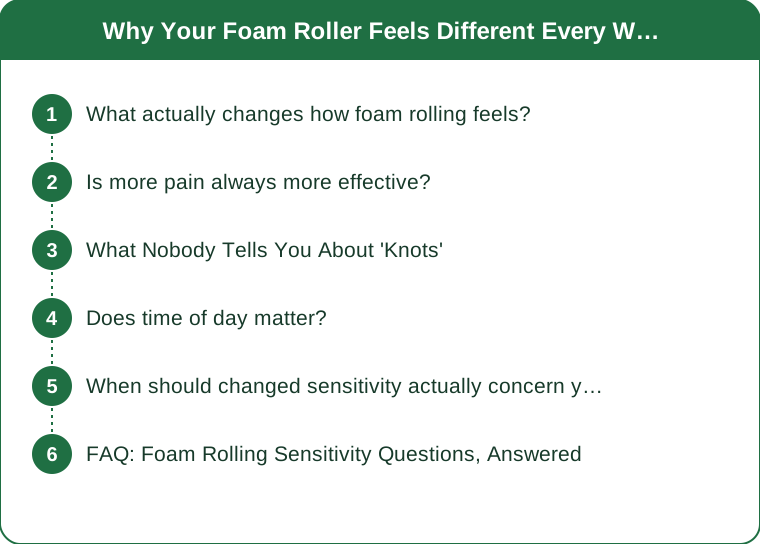
What actually changes how foam rolling feels?
Three variables shift daily and each one independently raises or lowers how much a given pressure hurts:
- Recent training load: a muscle worked hard in the last 24-48 hours has more microdamage and inflammation, which makes the exact same roller pressure register as more intense
- Sleep quality: poor sleep lowers your pain threshold measurably — the tissue isn’t more damaged, your nervous system is just more reactive to input
- Hydration: dehydrated fascia and muscle tissue is measurably less pliable, so the roller meets more resistance and that resistance reads as pain
None of these are visible from the outside, which is why ‘same spot, same roller’ can still feel completely different.
Is more pain always more effective?
No — this is one of the biggest misunderstandings in foam rolling. Pain intensity is not a proxy for how much benefit you’re getting. A day where a spot hurts more usually just means your tissue is in a more sensitized state, not that you’re ‘finally getting into the real knot.’
On high-sensitivity days, backing off pressure (or rolling for less time) gets you the same circulation and mobility benefit with far less unnecessary discomfort. Pushing through pain on those days trains your nervous system to brace, which can make future sessions worse, not better.
What Nobody Tells You About ‘Knots’
Here’s the uncomfortable truth: much of what people call a ‘knot’ that foam rolling is ‘breaking up’ is actually a temporarily sensitized nerve ending, not a physical tangle in the muscle fiber. Foam rollers can’t mechanically untie muscle tissue — what they do is desensitize the area and temporarily improve blood flow and perceived tightness.
This explains why the same spot can feel ‘gone’ after one session and ‘back’ three days later — nothing was permanently broken up or re-formed. It’s a nervous-system and circulation effect, which is exactly why consistency matters more than finding the one session that finally ‘gets it.‘

Does time of day matter?
Yes, noticeably. Muscles are generally less pliable first thing in the morning — reduced blood flow overnight and cooler tissue temperature both increase perceived stiffness. The identical roller pressure at 7am can feel meaningfully more intense than the same pressure at 6pm after a full day of movement.
If morning rolling consistently feels brutal, that’s not a sign something’s wrong — try a 2-minute light walk or arm-and-leg swings before you roll, which raises tissue temperature and often changes the sensation noticeably.
When should changed sensitivity actually concern you?
Day-to-day fluctuation in intensity is normal and expected. What’s worth paying attention to: sharp, localized, or worsening pain that doesn’t ease within the session, new numbness or tingling, or pain that gets progressively worse across multiple sessions rather than varying up and down. Those patterns are a reasonable trigger to see a physical therapist rather than push through with the roller. This is general information, not medical advice.
FAQ: Foam Rolling Sensitivity Questions, Answered
Why does rolling hurt more after a hard leg day?
Because that muscle has more microdamage and inflammation from training, which lowers its tolerance for the same pressure temporarily — this typically settles within 48-72 hours.
Should I roll harder on days it feels more sensitive?
No — ease off pressure or shorten the session on high-sensitivity days. More pain on those days reflects tissue state, not a knot finally releasing.
Does foam rolling actually break up scar tissue or adhesions?
Current evidence doesn’t support that mechanism for typical foam rolling pressure — the more likely effects are short-term nervous system desensitization and temporary blood flow changes, both still genuinely useful for mobility and recovery.
TL;DR:
- Foam rolling intensity varies day to day due to training load, sleep, and hydration — not the roller or the spot
- More pain does not mean more benefit; ease off on high-sensitivity days
- Most ‘knots’ are sensitized nerve endings, not physical tangles the roller is untying
- Sharp, worsening, or numb sensations across sessions are worth a professional look, not more pressure
Same roller, same spot, different day — that’s your nervous system and recovery state talking, not a sign you’re doing it wrong.
Keep Reading
This article is for general informational purposes only and is not medical advice. Always consult a qualified health professional for guidance specific to you.